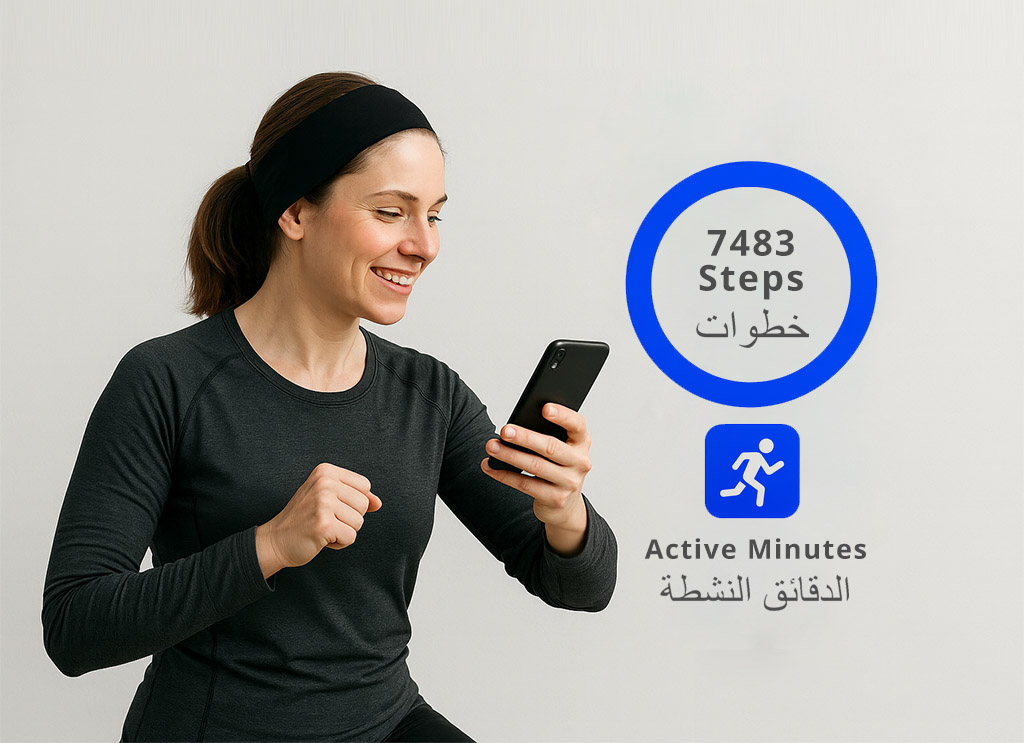
Employers in Saudi Arabia can lower health costs and improve productivity by pairing population-level wellness programs with objective movement data: wearable and in-clinic monitoring, AI-driven coaching, and advanced gait analysis. National trends show a significant burden from non-communicable diseases and physical inactivity, which makes targeted, measurable programs both a health priority and a financial opportunity. This article explains why movement data matters, how to design interventions, and how to measure ROI with a practical, anonymised model.
Why Saudi Arabia needs smarter corporate wellness (the facts that matter)
Non-communicable diseases (NCDs) and lifestyle conditions are a major economic and health burden in Saudi Arabia, with large direct and productivity costs that threaten employers and the broader health system. NCDs impose multi-billion dollar impacts on the national economy.
Insufficient physical activity is widespread and contributes measurably to morbidity and mortality; national public-health efforts emphasize prevention and increased activity. Targeting physical activity through workplace programs addresses a key upstream determinant of employee health.
The Saudi corporate wellness market is rapidly growing, driven by digital tools, wearables, and employer investment in prevention – creating a receptive environment for movement-based, tech-enabled programs.
What this means for you (reader): employers face preventable cost drivers and have an opportunity to capture savings by moving from generic benefits to targeted, measurable wellness that links activity to clinical and financial outcomes.
Movement data is the missing link: objective measures beat guesswork
Most workplace programs rely on self-reports or participation counts. Movement data changes the rules:
- Objective measures: movement scores, gait metrics, and sensor-derived analytics give clinicians and wellness teams measurable baselines and trends, removing guesswork.
- Actionable segmentation: objective risk stratification identifies high-risk employees who will likely generate the most near-term cost and who most benefit from targeted intervention.
- Better engagement: personalized coaching and gamified rewards tied to objective progress maintain behavior change and drive sustained participation.
Why this works: objective data connects participation to health signals (activity, balance, gait) that predict injury, chronic illness progression, and short-term absence – so interventions can be prioritised and evaluated.
Why 3D gait analysis matters for rehabilitation and high-risk employees
Not all movement data is equal. For clinical decision-making and return-to-work planning, 3D gait and biomechanical capture add value:
- Precision for clinicians: advanced gait capture provides kinematic and kinetic metrics (range of motion, symmetry, joint loading) that inform diagnoses and tailor rehabilitation plans. Studies demonstrate the reliability and validity of modern markerless and marker-based 3D systems.
- Non-invasive assessment: markerless and wearable systems lower barriers to repeated measurements (clinic, lab, or home), enabling longitudinal tracking without clinical disruption.
- Better RTW decisions: objective gait measures reduce subjective bias in return-to-work and accommodation decisions, which can shorten absence duration and lower indirect costs.
In short: for employees with MSK or neurological issues, gait analysis converts movement into treatment-ready insight and measurable improvement.


An anonymized, modeled case: how movement programs can cut insurance spend
Below is a modeled scenario – that shows how targeted movement programs can create measurable savings for a large employer in Saudi Arabia.
Context & assumptions (anonymised employer):
- 5,000 employees; annual employer health claims baseline = SAR 25,000,000.
- Targeted high-risk cohort ≈ 10% (500 employees) responsible for ~45% of claims (typical concentration pattern).
- Intervention: AI movement coaching + wearable monitoring + targeted clinical pathway (including gait assessment and rehab) launched to the high-risk cohort. Program cost year 1: SAR 1,250,000 (platform, wearables subsidies, clinician time, incentives).
- Conservative effect size: 15–30% reduction in claims among targeted cohort over 18 months due to fewer MSK claims, lower absence, and earlier RTW.
Modeled savings (range):
- If cohort claims were SAR 11,250,000 (45% of baseline), a 15% reduction = SAR 1,687,500 saved; 30% reduction = SAR 3,375,000 saved.
- Net of program cost (SAR 1,250,000), net savings range from SAR 437,500 to SAR 2,125,000 — i.e., ~1.7% to 8.5% reduction in total employer claims in year 1. Depending on design and longitudinal effects, savings can compound in years 2/3 and exceed this modeled example.
Why this is plausible: concentrated claims, the clinical impact of targeted rehabilitation, and behavior change driven by AI coaching can combine to reduce both direct claims and indirect productivity losses documented in the Saudi setting. (See national burden of NCDs and physical inactivity cited earlier.)
Designing a movement-first corporate wellness program (practical blueprint)
Follow these steps to move from a generic wellness program to a measurable, movement-driven system:
- Step 1 - Start with data collection (baseline): deploy short wearable or clinic assessments to create Motion Scores and identify high-risk employees. Use validated instruments where possible.
- Step 2 - Segment & prioritize: focus clinical resources on the top 5–15% highest-risk employees for targeted gait analysis and rehab. Use lighter AI coaching for the broader population.
- Step 3 - Integrate with benefits: align incentives, secondary prevention services, and referral workflows so clinicians, HR, and insurers can coordinate care.
- Step 4 - Measure outcomes monthly: monitor participation, Motion Score changes, absence days, and claims trends. Use a 6/18 month horizon for meaningful clinical and financial results.
- Step 5 - Iterate and scale: refine AI models, incentive structures, and clinical pathways based on early outcomes; scale the program across sites with the best-performing bundles.
Minimum data set to collect: Motion Score (composite), step/active minutes, balance/gait symmetry (if available), self-reported pain/limitations, claims and absence metrics.
Regulatory & privacy considerations in Saudi Arabia
- Ensure compliance with national data protection frameworks and health-data privacy rules. Use encryption, role-based access, and documented consent for clinical or sensitive analytics.
- Coordinate with insurance partners to streamline claims processing and to agree on shared KPIs. Public-private partnerships and national health strategies make Saudi Arabia receptive to integrated employer programs – but you must meet local compliance and clinical governance requirements.
Measuring success: KPIs and dashboard metrics
Primary KPIs:
- Change in target cohort claims (SAR) and claims per employee per year.
- Change in average Motion Score and gait symmetry within targeted cohort.
- Reduction in absence days and time to RTW.
- Participation and retention (30/90/180-day engagement rates).
- Net program ROI (savings minus operating costs).
Build a dashboard that links de-identified movement metrics with business outcomes and refresh it monthly. Provide HR and clinical leaders with role-based views: clinical teams see individual progress while HR sees aggregated risk and savings.
Common pitfalls - and how to avoid them
Pitfall: measuring participation but not outcomes.
Fix: link measurements to clinical and financial outcomes from day one.
Pitfall: poor privacy controls that block clinician adoption or employee trust.
Fix: implement privacy-by-design and transparent consent flows.
Pitfall: one-size-fits-all incentives that wear off.
Fix: tiered, personalized incentives and clinically driven referral triggers.
The future is hybrid: clinic + home + AI
Saudi employers should invest in a hybrid model:
- clinic-grade capture for high-risk and rehabilitation cases,
- wearables and phone sensors for population monitoring, and
- AI coaching for scalable personalization.
This hybrid model balances clinical precision, user convenience, and financial sustainability – and it aligns with the regional growth in digital health and corporate wellness services.
Key takeaways
Saudi employers should invest in a hybrid model:
- clinic-grade capture for high-risk and rehabilitation cases,
- wearables and phone sensors for population monitoring, and
- AI coaching for scalable personalization.
This hybrid model balances clinical precision, user convenience, and financial sustainability – and it aligns with the regional growth in digital health and corporate wellness services.
Suggested next steps (for HR & clinical leaders)
- Run a 6/9 month pilot: baseline screening (wearables + Motion Score), targeted clinical cohort, AI coaching, and a simple incentive.
- Measure claims, absence, and Motion Score deltas monthly.
- Share de-identified results with insurers to negotiate premium or program incentives.
- Scale with a hybrid tech + clinic model after documented ROI.
Further reading & sources
- WHO – Physical Activity: Saudi Arabia (Country Profile, 2022)
National activity data and policy context – baseline for physical inactivity rates and wellness intervention needs in Saudi Arabia. - WHO EMRO – Impact of Noncommunicable Diseases on Direct Medical Costs and Worker Productivity, Saudi Arabia
Evidence that NCDs impose considerable economic burden with workforce productivity losses more than six times larger than direct medical costs in Saudi Arabia. - UNDP – Prevention and Control of Noncommunicable Diseases in the Kingdom of Saudi Arabia: The Case for Investment
Economic burden analysis showing NCDs reduce economic output equivalent to 2.8% of Saudi Arabia’s GDP, with detailed ROI analysis for intervention programs. - Oxford Academic – Descriptive Pattern of Physical Activity in Saudi Arabia: Analysis of National Survey Data
Peer-reviewed research documenting that only 17.4% of Saudi adults meet physical activity guidelines, establishing the scale of the inactivity challenge. - Frontiers – Comprehensive Assessment of Physical Activity Policies and Initiatives in Saudi Arabia 2016-2022
Analysis of Saudi Vision 2030 health-enhancing physical activity policies and their implementation, providing context for corporate wellness opportunities. - Sensors (PubMed) – Accuracy, Validity, and Reliability of Markerless Camera-Based 3D Motion Capture Systems versus Marker-Based Systems in Gait Analysis: A Systematic Review and Meta-Analysis
Systematic review validating that markerless 3D gait analysis systems show good to excellent accuracy and reliability for spatiotemporal parameters and sagittal plane kinematics. - Journal of Occupational Rehabilitation – Effectiveness of Workplace Interventions in Return-to-Work for Musculoskeletal, Pain-Related and Mental Health Conditions
Strong evidence that multi-domain interventions (healthcare provision, service coordination, and work accommodation) significantly reduce work disability duration and costs for MSK conditions. - American Journal of Preventive Medicine – Return on Investment of Workplace Wellness Programs for Chronic Disease Prevention: A Systematic Review
Critical systematic review of workplace wellness ROI studies, providing methodological framework for evaluating program effectiveness and cost-benefit analysis. - Grand View Research – Middle East Digital Health Market Size & Industry Report, 2033
Market analysis showing Middle East digital health market projected to reach $69 billion by 2033 (CAGR 22.86%), with Saudi Arabia leading regional adoption of telemedicine, AI, and wearables. - Grand View Research – Saudi Arabia Wearable Medical Devices Market Industry Report, 2030
Market forecast showing Saudi wearable medical devices market growing at 20.6% CAGR to reach $956.43 million by 2030, driven by chronic disease management and remote monitoring needs.
For HR / Corporate Wellness Leaders
See MetaMotion Vitalytics in Action – Turn employee activity into measurable Motion Scores, AI coaching, and demonstrable wellness ROI.
For Clinics, Labs & Research Partners
Start a Clinic Lab or Research Pilot – Deploy clinic-grade capture (Vicon/IMU), lab setup, and research-grade analytics to power treatment and studies.